
Choosing a Nebulizer Compressor and Cup for Bronchiectasis
Not All Nebulizer Systems Are the Same: Why the Compressor and Cup Matter
For the first two years after my bronchiectasis and NTM lung disease diagnosis, I used a lightweight nebulizer compressor with tubing and a nebulizer cup.
It did what I needed it to do, and at the time, I didn’t give much thought to the science behind the equipment. I certainly didn’t realize that the compressor and nebulizer cup work together as a medication delivery system, and that the equipment we use can influence the aerosol that ultimately reaches our airways.
First, Let’s Clear Up the Terminology
One point that often causes confusion is the word nebulizer. Many of us use it to describe the entire setup, but technically there are several separate components.
The compressor is the machine that generates the airflow. The tubing carries that airflow from the compressor. And the nebulizer cup, sometimes called a medication cup or nebulizer handset, is where the saline or medication is placed and converted into an aerosol that can be inhaled.
So, if a manufacturer recommends replacing your “nebulizer” every six months, be sure you know which component they mean.
They may be referring to the nebulizer cup rather than the compressor itself. Compressors generally have much longer expected lifespans and warranties.
There Is a Lot of Science Behind That Little Mist Maker
A nebulizer doesn’t simply turn liquid into mist. It creates an aerosol containing droplets of different sizes, and the characteristics of those droplets help determine where the aerosol is likely to deposit within the respiratory tract.
Particle size is commonly described by measurements such as mass median aerodynamic diameter (MMAD). In general, larger aerosol particles are more likely to deposit higher in the respiratory tract, while appropriately sized smaller particles can travel farther into the bronchial tree and peripheral airways.
But particle size is only part of the story.
Researchers and manufacturers also evaluate factors such as aerosol output, respirable fraction, residual volume, treatment time, and the amount of medication delivered during inhalation.
Our breathing pattern matters too. How deeply and quickly we inhale, whether we pause briefly after inhaling, and how we exhale can all influence where aerosol deposits.
In other words, there is quite a bit happening between pouring saline into a nebulizer cup and getting that saline or medication where we want it to go.
Why the Compressor Matters Too
With a jet nebulizer, the compressor provides pressurized airflow to the nebulizer cup. That airflow helps the nebulizer convert the liquid into aerosol droplets.
This is why I don’t think of the compressor and cup as completely interchangeable pieces of equipment.
A compressor’s flow and pressure characteristics can affect how a particular nebulizer cup performs. Changing the compressor may potentially change aerosol output, particle-size characteristics, and treatment time.
Likewise, attaching a different nebulizer cup to a compressor may result in performance that differs from the system originally tested by the manufacturer.
That doesn’t necessarily mean that every mixed combination is unsafe or ineffective. It does mean that we shouldn’t automatically assume that every compressor and every nebulizer cup will perform exactly the same when paired.
Why I Changed My Nebulizer System
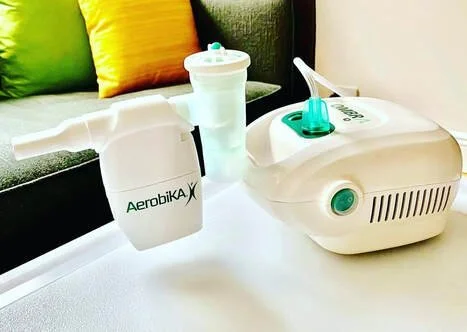
Several years after my bronchiectasis diagnosis, I upgraded to the Ombra® compressor paired with the AeroEclipse® XL reusable breath-actuated nebulizer. For the most part, I attach the cup to the back of my Aerobika and use them together as shown in the above photo.
Among the clients I have worked with who receive care at National Jewish Health, I have consistently heard about the use of the Aerobika® OPEP device in conjunction with the AeroEclipse® XL reusable nebulizer and Ombra® compressor for airway clearance. Although I have never been a patient there, I have great respect for their expertise and often incorporate evidence-informed recommendations from leading bronchiectasis centers into my own care.
What Is Different About a Breath-Actuated Nebulizer?
The AeroEclipse XL also differs from a conventional continuous-output jet nebulizer in that it can operate in breath-actuated mode.
In this mode, aerosol is generated primarily during inhalation rather than continuously throughout the breathing cycle. This can reduce the amount of aerosol released into the room during exhalation and between breaths. It may also help make more efficient use of the saline or medication placed in the cup.
I use this cup because I want the solution to go into my lungs and not my living room!
Maintenance Matters Too
Even a well-designed nebulizer system needs to be properly maintained.
Follow the manufacturer’s instructions for cleaning, disinfecting, and replacing the nebulizer cup, tubing, compressor filter, and other components.
Replacement schedules can vary considerably depending on the specific equipment, frequency of use, and manufacturer recommendations.
The compressor’s air filter is especially easy to forget about. A dirty or discolored filter can restrict airflow and potentially affect compressor performance, so it should be inspected regularly and replaced according to the manufacturer’s instructions.
And remember, tubing generally should not be washed or submerged unless the manufacturer specifically instructs you to do so.
If moisture or condensation enters the tubing, follow the manufacturer’s instructions for drying or replacement.
What About Other Nebulizer Systems?
PARI® and Philips Respironics® also manufacture compressors and nebulizer systems, and many other options are available.
The important point isn’t that everyone with bronchiectasis should use the same equipment I use.
Nebulizer systems are medical aerosol-delivery devices, and there is real science behind how they perform.
Before choosing a system simply because it is faster, quieter, smaller, less expensive, or recommended by someone in a support group, it is worth asking a few questions:
What compressor was this nebulizer cup designed and tested to work with?
What aerosol particle sizes does the system produce?
How much solution or medication is actually delivered?
How much remains in the cup?
How long does treatment typically take?
Is the nebulizer continuous-output or breath-actuated?
Can the equipment withstand the cleaning and disinfection method I need to use?
The Bottom Line
I used to think nebulizing was pretty straightforward: put saline in the cup, turn on the compressor, and breathe in the mist.
I now know there is much more science involved.
The compressor, nebulizer cup, airflow, pressure, aerosol characteristics, and even our breathing pattern all work together to determine how a nebulized treatment is delivered.
That’s why I believe it’s important to think of the compressor and nebulizer cup as a delivery system, rather than simply a collection of interchangeable parts.
And, as always, what I use for my airway clearance may not be what is best for you.
Bronchiectasis guidelines recommend that airway clearance be individualized and taught by an appropriately trained respiratory healthcare professional. If you are unsure whether your compressor and nebulizer cup are an appropriate combination, ask your respiratory therapist, pulmonologist, or equipment manufacturer.
Sometimes the little details really do matter, especially when we use this equipment every single day.
