
Precision Medicine in Bronchiectasis: Why One Size Doesn’t Fit All
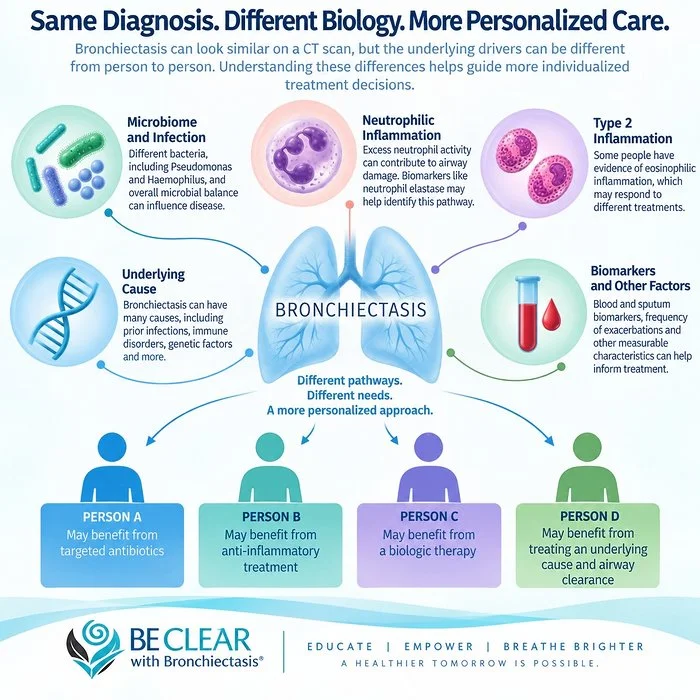
Because a bronchiectasis treatment worked for a friend does not mean it will work the same way for you.
If you have lived with bronchiectasis for any length of time, you have probably seen this happen. Someone in a support group tells you that a particular treatment completely changed their life. You try the exact same thing and wonder what all the excitement was about. Or maybe you are the person who responds beautifully to something that did very little for someone else. Why?
Professor James Chalmers opened his recent recap of the ERS Congress 2026 by talking about precision medicine. He described it as trying to predict when a treatment will work specifically for you. I immediately thought about how important this is for our bronchiectasis community, because bronchiectasis is not a single disease that behaves the same way in everyone.
Two people can have bronchiectasis that looks fairly similar on a CT scan and still have very different things going on inside their lungs. They may grow different bacteria, have different types or levels of inflammation, experience a very different number of exacerbations, and respond differently to the same treatment.
That is where precision medicine comes in. The idea is to better understand those differences so treatment can become more individualized. It is not necessarily about discovering one new miracle drug. It is about getting better at figuring out which treatment might work for which person, and when.
Moving Beyond “Try It and See”
A lot of medicine still involves some trial and error. Try a treatment. See what happens. If it does not help, adjust it or try something else. But wouldn’t it be wonderful if we could make more of those decisions based on information we already have about the individual?
Can we predict whether someone is likely to respond to a particular antibiotic? Can we identify who is more likely to remain stable and who is at greater risk of disease progression? Could we eventually get better at matching people with the airway-clearance techniques that work best for them? This is where precision medicine is heading.

Instead of looking only at the diagnosis of bronchiectasis, researchers are digging deeper. They are looking at the bacteria living in our airways, patterns of inflammation, blood and sputum biomarkers, underlying causes, and other measurable characteristics. In other words, don’t just tell me I have bronchiectasis. Tell me more about my bronchiectasis.
The Microbiome: There Is a Lot Going On in Our Airways
The lung microbiome is one of the areas of bronchiectasis research that fascinates me the most. We now know that our airways contain communities of microorganisms. Researchers are interested not only in which organisms are there, but also in how the balance of that entire community may influence our disease.
You may hear the word dysbiosis. In simple terms, this refers to a disruption in the microbial community, often involving less diversity and greater dominance by certain potentially harmful organisms. One organism that gets a lot of attention in bronchiectasis is Pseudomonas aeruginosa.
Research has linked Pseudomonas with worse outcomes in bronchiectasis, including more frequent exacerbations. Studies have also associated Pseudomonas- and Haemophilus-dominated microbiomes, as well as lower microbial diversity, with more severe disease and frequent exacerbations. But simply knowing that Pseudomonas is present may not tell us the whole story. What else is living alongside it may matter too.
And this is where it gets especially interesting. Researchers are identifying patterns in the airway microbiome that may be associated with disease severity and the risk of exacerbations. Some studies are even looking at whether machine-learning models can use microbiome information to help predict clinical outcomes. This is exciting research, but we are not yet at the point where a microbiome profile can routinely tell your doctor exactly how to treat you.
Imagine, though, a future in which your sputum tells your bronchiectasis team much more than simply, “This bacterium grew.” Maybe it could help them understand how your disease is behaving, how closely you need to be monitored and, eventually, how a particular finding should be treated.
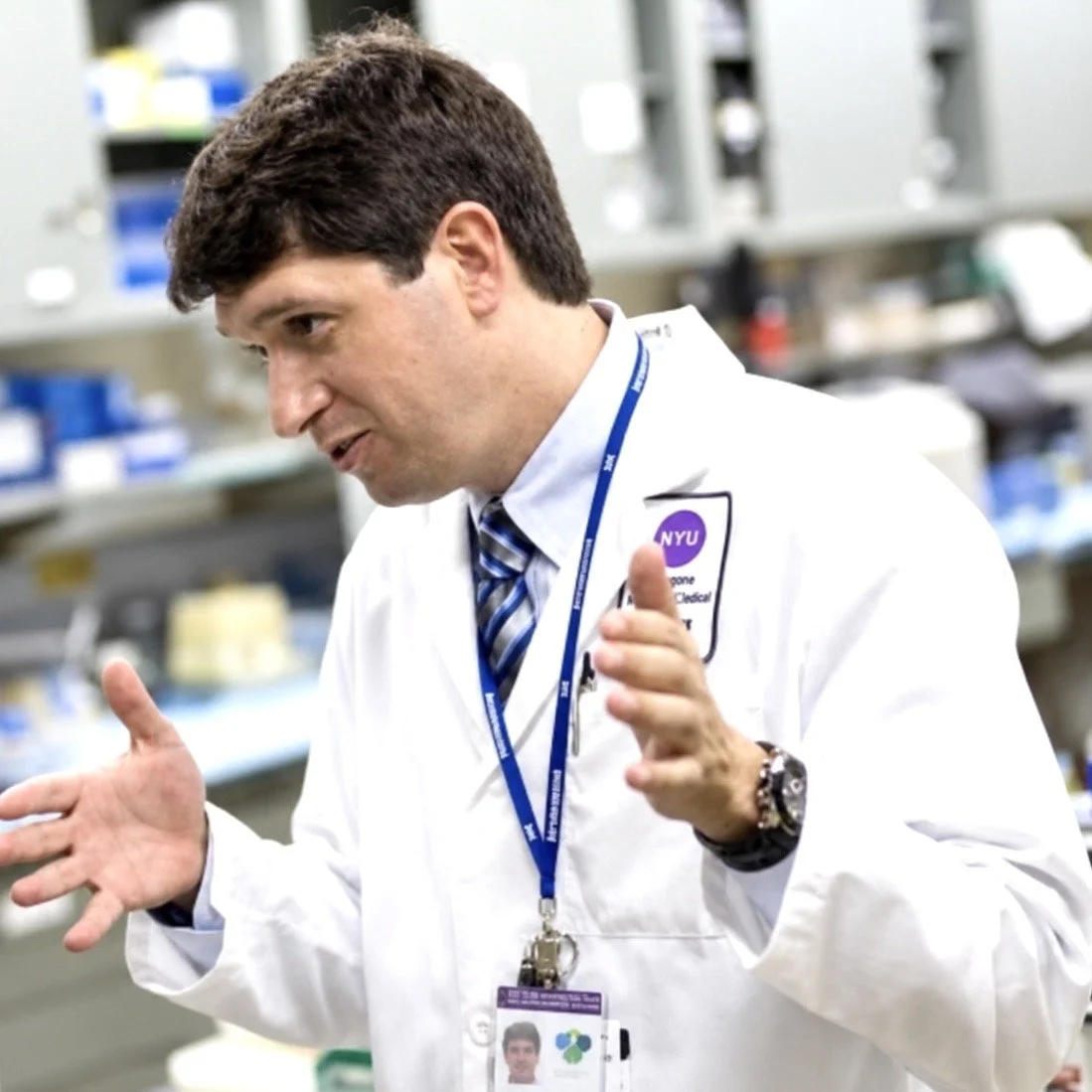
I had the opportunity to see some of this work firsthand when I visited Dr. Leopoldo Segal’s lung microbiome lab at NYU Langone. His team focuses specifically on the lung microbiome, including microorganisms that may not be detected by routine culture methods and may influence whether we experience exacerbations. Standing in that lab made all of this feel much less abstract to me. These researchers are looking for the individualized answers so many of us are hoping for.
Measuring Inflammation Instead of Assuming It
Another major part of precision medicine is inflammation. If you have been following bronchiectasis research lately, you have probably heard quite a bit about neutrophils.
Neutrophils are immune cells that help us fight infection, which is obviously something we need them to do. But in bronchiectasis, excessive or poorly controlled neutrophilic inflammation can also contribute to airway damage.
One of the substances released by neutrophils is neutrophil elastase. Researchers are studying neutrophil elastase and other biomarkers to better identify people whose bronchiectasis may be driven by this inflammatory pathway. Some of these biomarkers are becoming increasingly important in research and clinical trials, but many are not yet routinely measured or used to choose treatments during an everyday bronchiectasis appointment.
One example of this research making its way into treatment is brensocatib, a DPP-1 inhibitor. DPP-1 helps activate neutrophil serine proteases, including neutrophil elastase, during neutrophil development. By inhibiting DPP-1, brensocatib reduces the activity of these enzymes, thereby reducing airway inflammation and damage.
In the United States, brensocatib, sold as BRINSUPRI, is FDA-approved for non-cystic fibrosis bronchiectasis in adults and children ages 12 and older. That does not mean it is the right treatment for every person with bronchiectasis. But I think it is a great example of where bronchiectasis treatment is heading: targeting a particular disease pathway rather than simply treating symptoms.

Other approaches aimed at modifying neutrophilic inflammation are also being studied. And the goal is not simply to “turn off” inflammation. We need our immune system. The challenge is finding ways to reduce the harmful effects of excessive neutrophil protease activity while preserving the infection-fighting functions our bodies need.
Not Everyone Has the Same Type of Inflammation
Here is another great example of why one size does not fit all. Bronchiectasis has traditionally been thought of primarily as a neutrophilic disease, but researchers have identified a subgroup of people with evidence of type 2, or eosinophilic, inflammation.
You may already be familiar with eosinophils if you have asthma or if you have ever looked closely at your lab tests. For some people with bronchiectasis, an elevated eosinophil count may give doctors another clue about the biology driving their disease.
Researchers are studying whether people with evidence of type 2 inflammation may respond differently to certain treatments, including biologic therapies already used for other type 2 inflammatory diseases. These therapies are not routine treatments for bronchiectasis for everyone, but this is an area researchers are actively exploring.
This brings us to another term you may hear more often: treatable traits. I really like this concept. Instead of saying, “You have bronchiectasis, so everyone gets the same treatment,” we start asking: What is happening in your body that we can identify, measure, and potentially treat?
What Does This Mean for Us Today?
Some of the tools being studied in precision medicine still live primarily in the research world. They are not things most of us are going to have measured at our next bronchiectasis appointment. But I think understanding where the science is going can help us become better partners in our own care.
It is also another reason to know as much as we reasonably can about our own bronchiectasis. What organisms have grown in our sputum? What do our blood tests show? Are any of those results meaningful when considered alongside our symptoms and medical history? Has an underlying cause for our bronchiectasis been identified? What pattern has our disease followed over time?
These are the kinds of conversations we can have with our bronchiectasis specialists. And, as always, one laboratory number, sputum result, or biomarker should never be interpreted all by itself. It is one piece of a much bigger picture.
Questions and Answers About Precision Medicine and Bronchiectasis
What is precision medicine in bronchiectasis?
Precision medicine uses information about an individual and their disease to guide treatment, rather than assuming everyone with bronchiectasis should be treated the same way. That information might include airway microbiology, inflammatory patterns, biomarkers, underlying causes, and clinical history.
Why can the same bronchiectasis treatment work for one person but not another?
There can be significant differences between people living with bronchiectasis. Even two people with similar-looking CT scans may grow different organisms, have different underlying causes, or have very different patterns of inflammation. Those differences may influence how they respond to treatment.
What is a treatable trait in bronchiectasis?
A treatable trait is a specific characteristic of someone’s disease that can be identified and may help guide management. It could be an airway infection pattern, excess neutrophilic inflammation, type 2 inflammation, reflux, impaired mucus clearance, or another factor that may be relevant to symptoms and risk.
Not every trait has a proven targeted treatment yet. But identifying these differences may help clinicians individualize care.
What does the lung microbiome have to do with bronchiectasis?
The lung microbiome refers to the community of microorganisms living in our airways. Researchers are studying whether changes in the diversity and balance of these microorganisms are associated with exacerbations, inflammation, disease severity, and the progression of bronchiectasis over time.
These associations are important, but microbiome testing is not yet a standard tool for directing most day-to-day bronchiectasis treatment.
Is microbiome testing the same as a sputum culture?
No. A routine sputum culture looks for specific organisms that can be grown and identified in the laboratory. Microbiome research can look more broadly at the community of microorganisms in the airways and how they may interact with one another.
Much of this more detailed testing is still primarily being used in research rather than routine clinical care.
What do eosinophils have to do with bronchiectasis?
Although bronchiectasis is often associated with neutrophilic inflammation, some people have evidence of eosinophilic, or type 2, inflammation. Researchers are studying whether identifying this subgroup could eventually help determine who might benefit from particular treatments.
Biologic therapies targeting type 2 inflammation are being studied for bronchiectasis, but they are not a routine treatment for everyone with the condition.
Can precision medicine tell my doctor exactly which bronchiectasis treatment will work for me?
Not yet. Precision medicine cannot reliably tell a clinician exactly which treatment will work for every individual with bronchiectasis.
But we are beginning to see treatment become more targeted in some areas, including therapies that target neutrophil serine protease activity. Research continues to move us toward more informed decisions based on an individual’s inflammation, microbiology, clinical history, and underlying cause.
A Thought From Linda
One of the most important things I have learned since being diagnosed with bronchiectasis is not to assume that what works for someone else will necessarily work for me. We can learn so much from each other. I certainly have. But our lungs, our microbiology, our underlying causes, our inflammation, and our histories are not identical.
It is also why I chose to join the NYU Biobank, which gives researchers access to my data and bodily samples, even though I often do not qualify for clinical studies for bronchiectasis or MAC infections because of my low frequency of exacerbations. If our data and samples can help researchers find these patterns sooner, that feels like a meaningful way to contribute. It makes me feel like a real partner in research rather than someone waiting on the sidelines for answers.
That is why I find precision medicine so encouraging. The future of bronchiectasis care may be less about simply asking, “What do we give people with bronchiectasis?” and much more about asking, “What is happening in this particular person, and what can we do about it?”
To me, that feels like a very important step forward.
Want to Learn More about Bronchiectasis?
The BE CLEAR® Guide to Bronchiectasis is designed to help you understand and manage your chronic lung condition at your own pace. Whether you’re newly diagnosed or looking to strengthen your daily routine, the guide offers expert-informed content, practical suggestions, and compassionate support every step of the way.
